



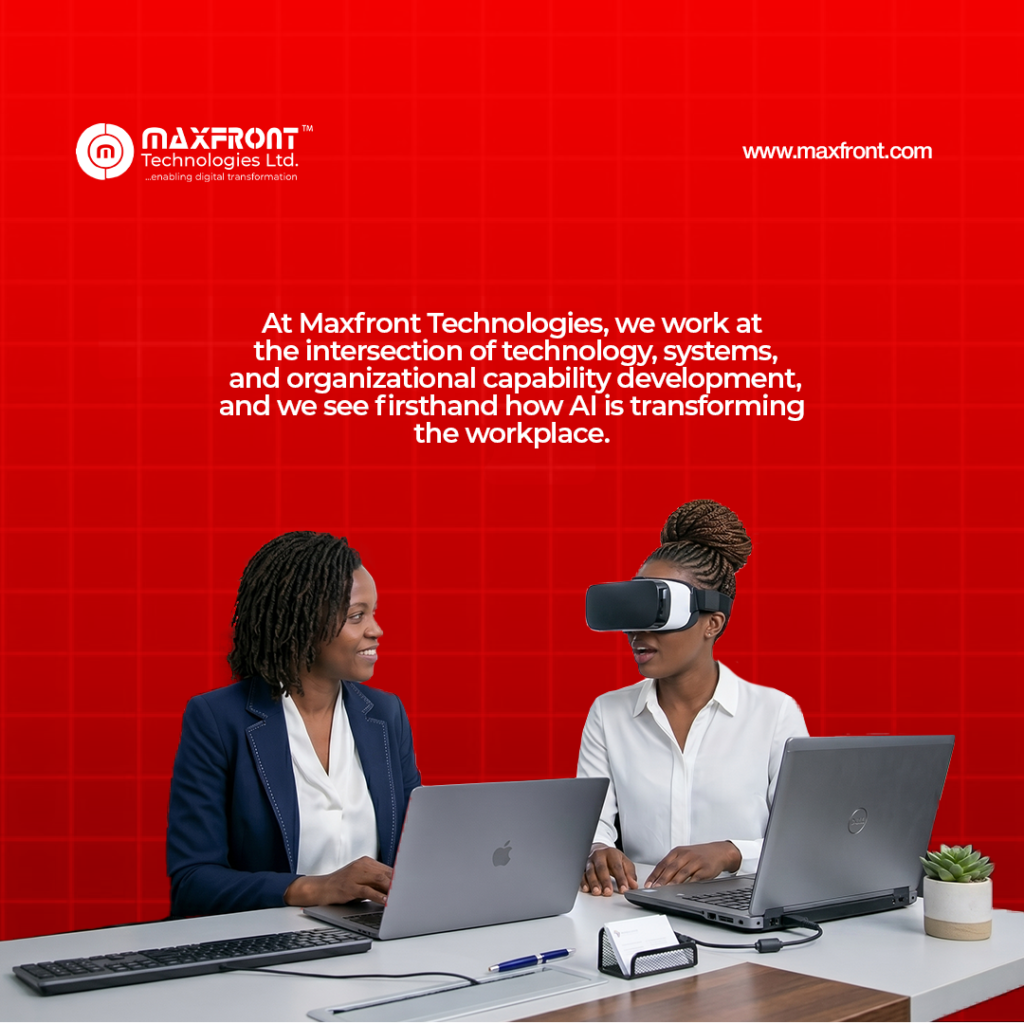
As artificial intelligence continues to reshape industries and redefine how work gets done, professionals and organizations must rethink the skills, tools, and strategies required to remain relevant. At Maxfront Technologies, we work at the intersection of technology, systems, and organizational capability development, and we see firsthand how AI is transforming the workplace. This article explores the skills, risks, and opportunities that define tech careers in the age of AI
The nature of work is changing.
Not gradually, but fundamentally.
Artificial intelligence is no longer a future concept. It is actively reshaping how work gets done, how decisions are made, and how value is created. Tools like ChatGPT have made AI accessible to millions, but their real impact is being felt deeper within organizations.
For professionals in tech and those looking to enter, the question is no longer whether AI will affect their careers.
It is how prepared they are for what comes next.
1. The Skills That Now Matter Most
Technical skills alone are no longer enough.
While programming, data analysis, and system design remain important, the rise of AI has shifted demand toward a new combination of capabilities:
- Understanding how to work with AI tools, not just build them.
- The ability to interpret data and turn insights into business decisions.
- Strong problem-solving and critical thinking skills.
- Clear communication, especially in translating technical outcomes for non-technical stakeholders.
In this new landscape, the most valuable professionals are not just technical experts.
They are translators between technology and business value.
2. AI Is Changing Roles, Not Just Replacing Them
There is a lot of concern about job displacement, and it is valid.
Some repetitive and rule-based roles are already being automated. Tasks like basic data entry, simple customer responses, and routine reporting are increasingly handled by AI systems.
But this is only part of the story.
At the same time, entirely new roles are emerging:
- AI specialists who design and manage intelligent systems.
- Data professionals who structure and interpret complex datasets.
- Automation experts who build workflows that integrate AI into operations.
Even traditional roles are evolving. Developers are now expected to work alongside AI copilots. Analysts are expected to deliver insights faster. Customer support teams are becoming more strategic, handling complex and high-value interactions.
The shift is not about fewer jobs.
It is about different jobs.
3. The Risks Professionals Must Understand
With opportunity comes risk.
One of the biggest challenges is skill obsolescence. Technologies are evolving quickly, and professionals who do not adapt risk becoming irrelevant.
There is also the risk of over-reliance on AI. Blindly trusting automated outputs without validation can lead to poor decisions, especially in high-stakes environments like finance or government.
Security and data privacy concerns are also increasing, as AI systems rely heavily on large volumes of sensitive data.
To remain valuable, professionals must do more than adopt AI.
They must understand its limitations.
4. Opportunities for Those Who Adapt Early
For those willing to evolve, the opportunities are significant.
AI is lowering the barrier to entry in many areas. Individuals can now perform tasks that previously required entire teams, whether it is building prototypes, analyzing data, or creating content.
This creates room for:
- Faster career growth for adaptable professionals.
- New income streams through freelance and remote opportunities.
- The ability to work across industries, as AI skills are highly transferable.
In many ways, AI is not just changing jobs.
It is expanding what individuals are capable of achieving.
5. Building a Future-Ready Career
Success in the age of AI requires intention.
Professionals should focus on:
- Continuous learning, staying updated with tools, trends, and applications.
- Practical application, working on real projects, not just theory.
- Building a portfolio that demonstrates both technical and business impact.
- Developing a mindset that embraces change rather than resists it.
The goal is not to compete with AI.
It is to work effectively alongside it.
Maxfront as a Partner in Career and Capability Development
Navigating this shift requires more than awareness.
It requires structure and guidance.
At Maxfront Technologies, we support organizations and professionals in building the capabilities needed for an AI-driven world.
Our approach includes:
- Designing systems that integrate AI into real business workflows.
- Supporting teams with the tools and frameworks needed to adapt quickly.
- Enabling data-driven environments where professionals can focus on high-value work.
- Bridging the gap between technology and practical application across industries.
We do not just implement solutions.
We help build the people and systems that sustain them.
The Future Belongs to the Adaptable
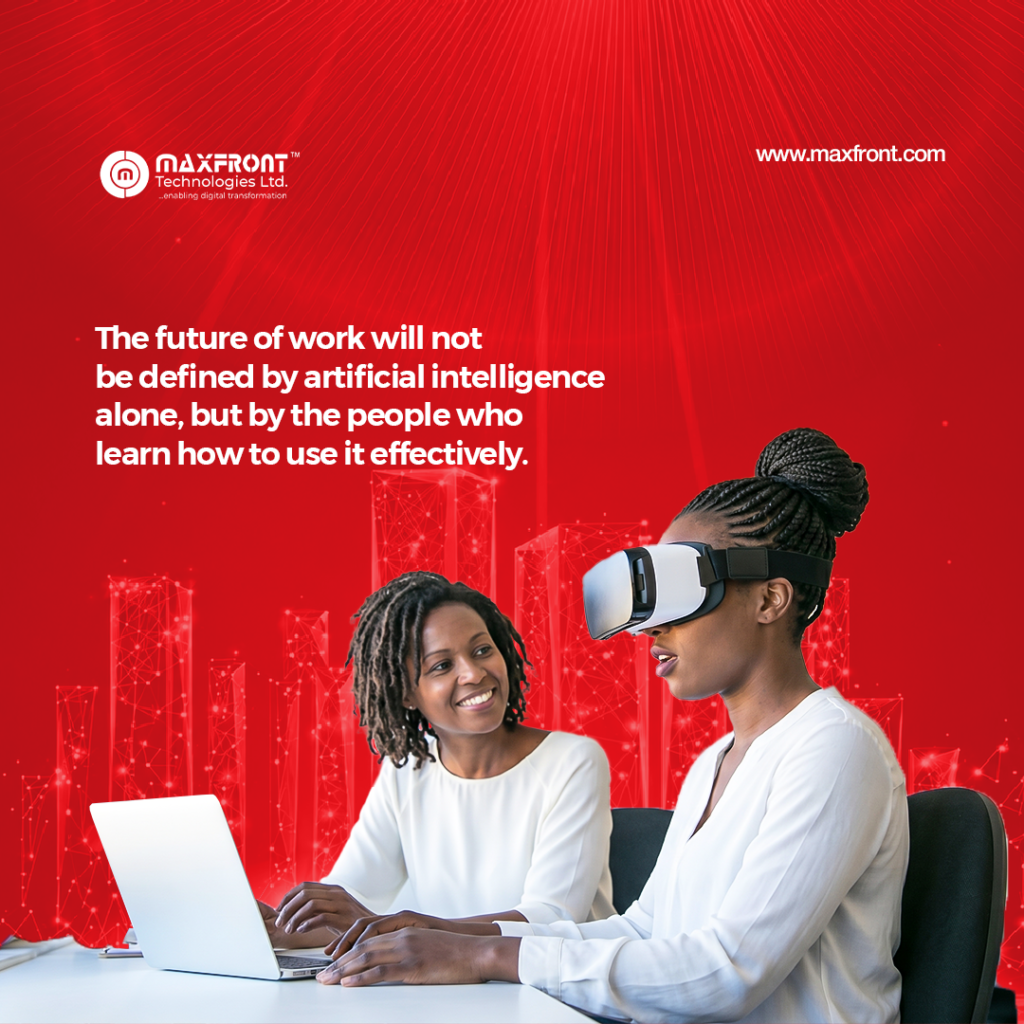
The future of work will not be defined by artificial intelligence alone, but by the people who learn how to use it effectively.
The professionals and organizations that will thrive are those that invest in skills, systems, and continuous learning. AI is not just a tool for automation; it is a platform for innovation, productivity, and new opportunities.
At Maxfront Technologies, we help organizations and professionals build the systems, capabilities, and strategies required to succeed in an AI-driven world.
Do not wait for the future of work. Prepare for it.
Contact us at info@maxfront.com to learn how we can support your digital transformation and capability development journey.