



Many businesses may not realize how quickly things are changing.
By 2027, cybersecurity will be very different from today. AI-powered malware will work on its own. Quantum computing will threaten basic encryption. The focus will move from network borders to the algorithms that drive businesses.
Security leaders need to act now. The future has already arrived, so preparation should start right away.
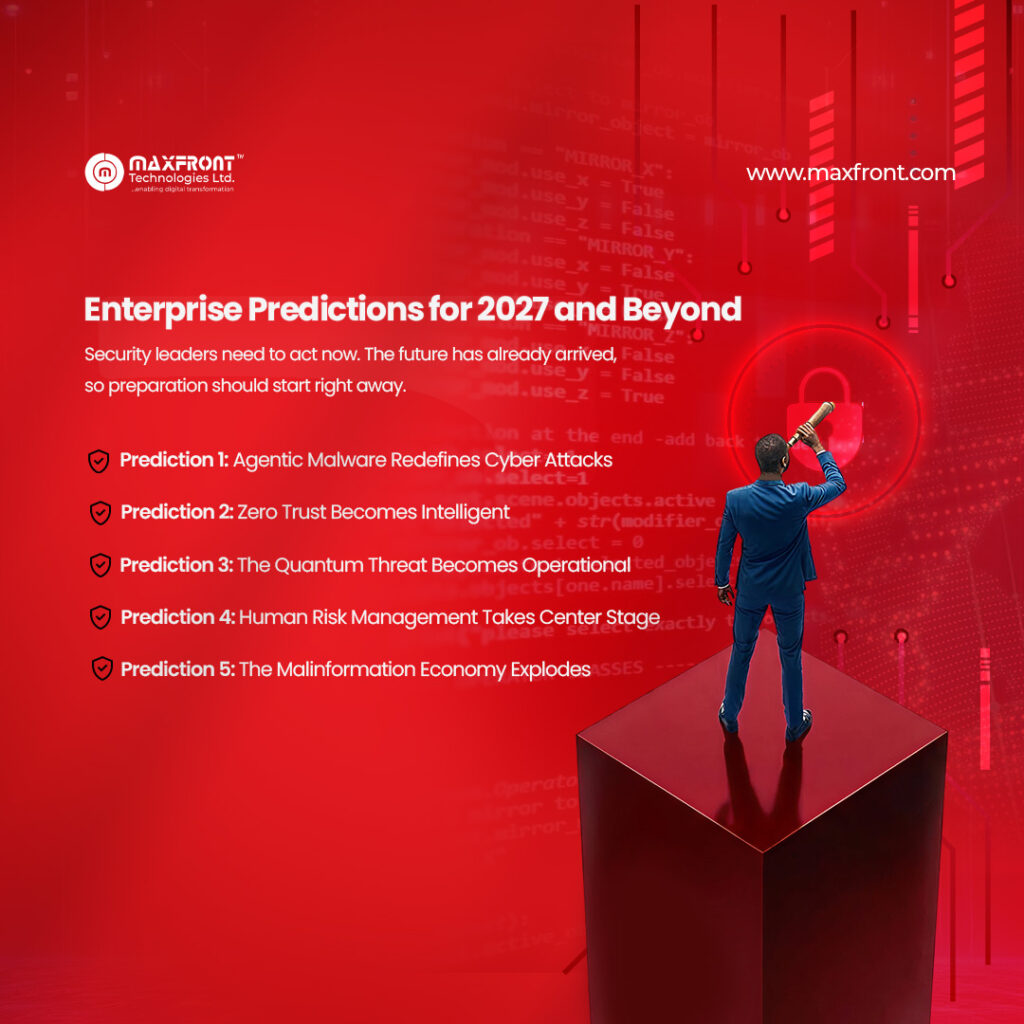
Prediction 1: Agentic Malware Redefines Cyber Attacks
In the next few years, businesses will face more agentic malware. This is autonomous, AI-driven malicious software that can work without human control.
Traditional malware follows set instructions, but agentic malware can think, adapt, and change with each attack. The National Cyber Security Centre has already seen a big increase in AI-enabled cyber activity and more severe attacks in recent years.
What this means:
Signature-based defenses will not work anymore. Organizations need to use AI-first security strategies that can keep up with machine-driven threats.
Prediction 2: Zero Trust Becomes Intelligent
Zero Trust Architecture is now essential for businesses, not just a buzzword. The next step is intelligent Zero Trust.
Gartner says most businesses are still working on fully adopting Zero Trust. Leading companies are already using AI to enforce policies, spot unusual activity, and adjust access in real time without hurting the user experience.
What this mOrganizations that wait to adopt Zero Trust will have trouble protecting hybrid teams, cloud systems, and growing digital networks.stems.
Prediction 3: The Quantum Threat Becomes Operational
Quantum-powered cyber threats are coming sooner than expected. Quantum computers will soon be able to break common encryption methods like RSA and ECC, putting sensitive data and key infrastructure at risk.
The National Institute of Standards and Technology has already released new cryptography standards for the post-quantum era, showing that organizations need to prepare now.
What this means:
Being able to quickly update encryption is now a must. Companies should start moving to quantum-resistant encryption right away. Waiting until the threat arrives will be too late.
Prediction 4: Human Risk Management Takes Center Stage
More CISOs are moving away from standard security training and focusing on managing human-related security risks.
Even with better technology, people are still the main target for attacks. Companies that use AI to analyze behavior and offer personalized security measures see fewer incidents caused by employees.
What this means:
Security awareness will be ongoing, flexible, and based on data. The yearly compliance video will disappear, replaced by real changes in company culture.
Prediction 5: The Malinformation Economy Explodes
Malinformation, which is true information shared to cause harm, is quickly becoming a big threat to businesses. Gartner says that fighting malinformation and information warfare will take up more of cybersecurity and marketing budgets.
What this means:
CISOs need to invest in tools and strategies to spot, study, and stop coordinated information attacks before they harm brand reputation and trust.
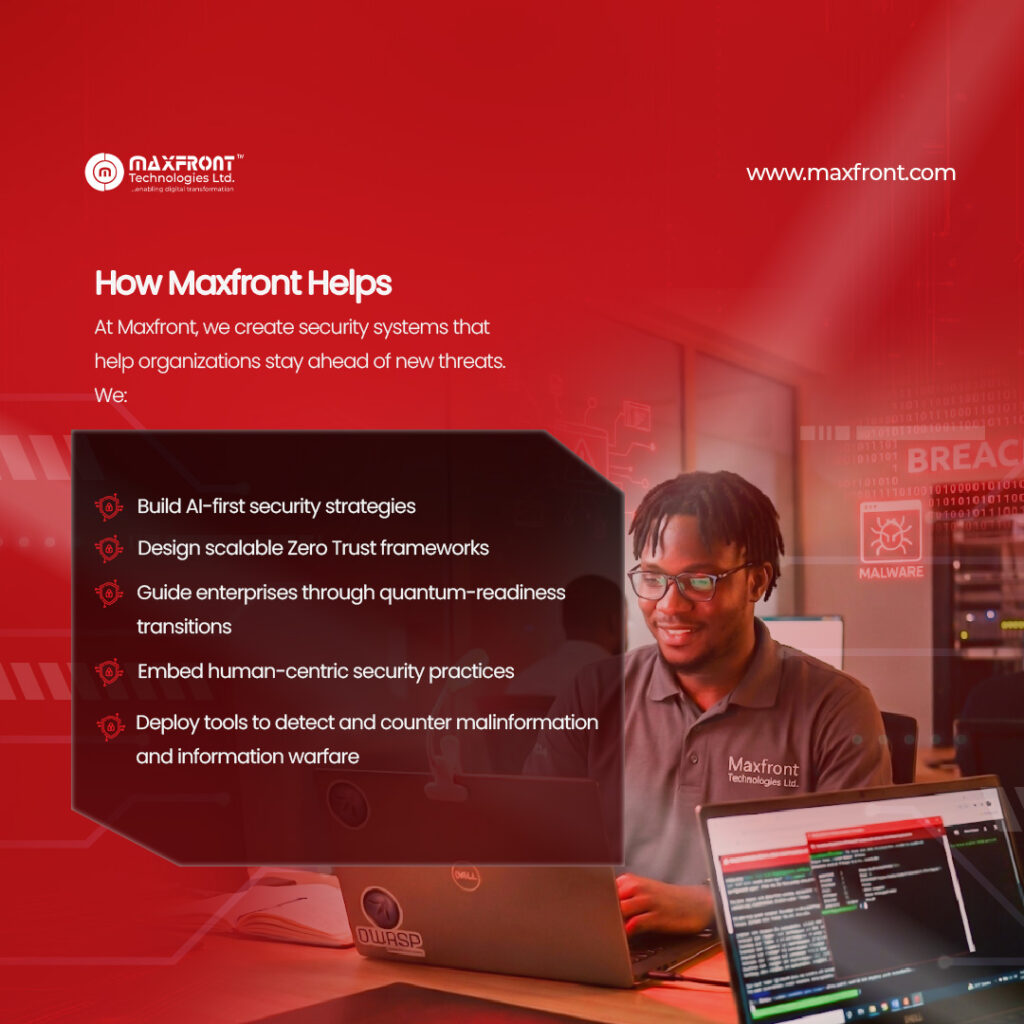
How Maxfront Helps
At Maxfront, we create security systems that help organizations stay ahead of new threats.
We:
- Build AI-first security strategies
- Design scalable Zero Trust frameworks
- Guide enterprises through quantum-readiness transitions
- Embed human-centric security practices
- Deploy tools to detect and counter malinformation and information warfare
Are you ready to strengthen your security and stay ahead of future threats?
📩 Contact us at info@maxfront.com
At Maxfront, we help organizations turn cybersecurity from just a defense into a real business advantage.
#Cybersecurity, #CyberSecurityTrends, #FutureOfCybersecurity, #ArtificialIntelligence, #AICybersecurity, #AgenticAI, #AIMalware, #CloudSecurity, #HybridWorkSecurity, #EnterpriseIT, #CISO, #SecurityLeaders ,#TechLeadership, #RiskStrategy, #BusinessContinuity, #Maxfront, #SecureWithMaxfront, #CyberLeadership, #FutureSecure