




The next billion users don’t speak English.
That simple fact is reshaping how technology companies think about growth. For years, global expansion meant building for English-speaking markets first and translating later, if at all. That sequencing no longer works.
Research consistently shows that people prefer buying products in their native language. A significant majority of consumers are more comfortable purchasing when information is in their own language, and many say they simply won’t buy from websites in other languages at all. Language isn’t just about communication anymore. It’s about revenue, trust, and market access.
Here’s what technology leaders need to understand about localisation and why it’s becoming a board-level conversation.
What’s the Difference Between Translation and Localisation?
Translation, localisation, and internationalisation aren’t the same things. Confusing them leads to wasted money and misaligned expectations.
Translation adapts the message, ensuring meaning carries across even when words change. Localisation goes deeper. It adapts the entire experience: date formats, currencies, cultural references, visual design, and workflows. Internationalisation happens at the code level, building your product so it can handle different writing systems, text directions, and regional formats without requiring engineering changes.
A well-localized product doesn’t feel “translated.” It feels like it was created for you from the start.
Why is AI making localisation More Complicated?
Artificial intelligence has made it possible to generate multilingual content almost instantly. But speed without strategy creates new risks.
Research shows that large language model safeguards don’t reliably carry over beyond English. Performance drops sharply in low-resource languages, disproportionately impacting the very growth markets companies are trying to reach. Models can misinterpret tone, audience, and terminology when they lack rich contextual cues.
Multimarket content depends on brand voice, intent, cultural understanding, and regulatory nuance. Organisations that rely on out-of-the-box localisation AI quickly discover that the phrase “it looked fine in English” does not constitute a proper quality-assurance process.
What Technical Foundations Matter Most?
Localisation-ready systems start with smart engineering. Teams that think globally on day one save hundreds of hours of rework later.
This means externalising all user-facing texts rather than hardcoding them. It means using placeholders instead of concatenating strings, because concatenation works in English but breaks in languages with different grammar rules. It means designing for text expansion, since translations can be significantly longer or shorter than the source.
As one industry expert puts it, think of internationalisation as the house and localisation as the home. Internationalisation is the foundation and plumbing. Localisation is the paint colours and finishes. If you have to redo the walls first, furnishing takes much longer.
Why Doesn’t Technology Alone Fix the Problem?
This is where many organisations get stuck. They see localisation as a technology problem that requires a better tool. But what looks like a technology issue is often a deeper transformation challenge.
Without unified workflows, a new tool simply automates chaos. Different teams manage the same tasks in completely different ways. Manual effort and redundant data entry are pervasive yet hidden until someone digs deeper.
Technology cannot fix fragmentation. Organisations must redesign how work happens—defining roles, handoffs, and outcomes—before technology can ever be an enabler. You have to design the city before you pick the buses.
How Maxfront Helps
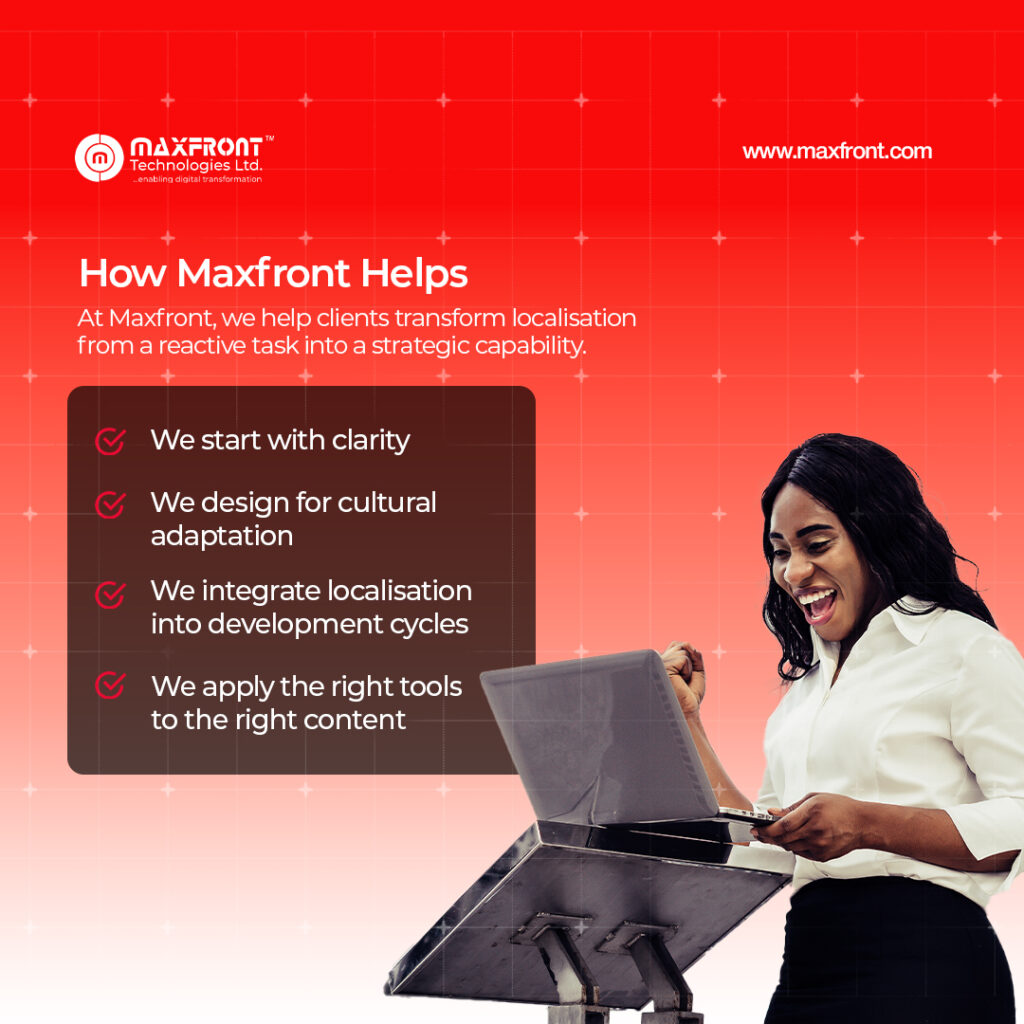
At Maxfront, we help clients transform localisation from a reactive task into a strategic capability.
We start with clarity: Our teams assess whether your systems can handle global requirements, Unicode support, locale-aware formatting, and design patterns that scale. We help you build foundations that last.
We design for cultural adaptation: beyond words, we evaluate how your product needs to behave in different markets. Date formats, currency handling, workflow expectations, and visual design all get assessed through a local lens.
We integrate localisation into development cycles: When localisation happens continuously and not in quarterly batches, your global customers will always see current, accurate information. We build workflows that keep multilingual content in sync with product changes.
We apply the right tools to the right content: AI accelerates low-risk material. Human expertise handles what matters most. We help you establish review processes that balance speed with accuracy.
We measure what matters. User adoption in new markets, conversion rates by language, and support ticket deflection tell you whether your strategy is working. We help you track them and iterate based on real data.
The Bottom Line
The default customer is no longer English-first. The next wave of users is global, multilingual, and increasingly expectant that technology will meet them where they are.
Companies that treat localisation as infrastructure, not a one-time project, will capture markets that competitors can’t reach. They’ll build trust faster, convert more customers, and generate fewer support tickets.
At Maxfront, we build the foundations that make global growth sustainable.
Ready to reach the next billion users? Contact us at info@maxfront.com.