



Businesses are under constant pressure to reduce operating costs, improve efficiency, and deliver better customer experiences. At the same time, advances in artificial intelligence (AI) and automation are creating opportunities for organisations to rethink how they manage everyday tasks and processes.
From customer service and data processing to reporting and administrative operations, businesses can automate many repetitive activities that once required significant employee time.
But as organisations increase their use of AI and automation, an important question is emerging: How can businesses improve efficiency without losing the human element that customers value?
The answer is not necessarily to choose between technology and people. Instead, businesses can use technology to augment human capabilities, automate routine work, and give employees more time to focus on activities where human judgement and interaction create the greatest value.
Why Are Businesses Turning to AI and Automation?
Many organisations spend significant time and resources on repetitive activities. These may include responding to frequently asked questions, entering data, processing documents, scheduling appointments, generating reports and sending routine communications.
Automating these processes can reduce the time employees spend on administrative work while improving speed, consistency, and scalability.
AI can also help organisations analyse large volumes of information, identify patterns and generate insights that support decision-making.
When implemented effectively, these technologies can help businesses:
- Reduce operational costs
- Improve productivity and efficiency.
- Reduce errors in repetitive processes.
- Respond to customers more quickly.
- Enable employees to focus on higher-value activities.
- Scale operations more effectively
However, the business case for automation should go beyond simply reducing headcount. The greater opportunity may be to redesign work so that technology handles repetitive activities while people focus on tasks that require judgement, creativity, and relationship-building.
The Human Element Still Matters
While AI can handle many routine interactions, customers still need human support in some situations.
For example, an automated system can answer a straightforward question about a product, service or process. However, a customer dealing with a complex complaint or sensitive issue may need to speak with someone who can understand the context, exercise judgement and provide a personalised response.
This is particularly important for businesses that depend on customer relationships, trust and long-term loyalty.
The objective, therefore, should not be to remove human interaction wherever automation is possible. Instead, organisations can use automation to manage routine interactions, allowing employees to focus on situations that require empathy, judgement, creativity and problem-solving.
In many cases, the quality of the customer experience will depend not on how much a business automates, but on where it chooses to retain the human touch.
Using Automation to Empower Employees
AI and automation can also give employees more time to focus on higher-value work.
A customer service representative who spends less time answering repetitive questions can devote more attention to resolving complex customer issues.
An administrative employee who no longer needs to transfer information between systems manually can spend more time coordinating operations and supporting other teams.
Similarly, managers can use automated reports and data analysis to spend less time gathering information and more time interpreting insights and making strategic decisions.
This shift can benefit both the organisation and its employees. By reducing repetitive workloads, businesses can create more opportunities for employees to apply skills that technology cannot easily replicate, including critical thinking, collaboration, creativity and relationship management.
In this way, automation can become a tool to augment the workforce rather than replace it.
Businesses Need to Know What to Automate
Not every business process should be automated.
Organisations should first identify where automation can address a genuine business challenge and deliver measurable value. Repetitive, predictable, time-consuming, rules-based processes may be strong candidates for automation.
By contrast, processes involving sensitive decisions, complex customer relationships or significant financial and operational consequences may require a higher level of human oversight.
Businesses should also avoid automating inefficient processes without first reviewing how those processes work.
Automating a poorly designed process does not necessarily improve it; it may simply make the inefficiency happen faster.
A more effective approach is to understand the process first, identify unnecessary steps, and determine where technology can create meaningful improvements. Automation should be part of a broader process-improvement strategy, not an objective in itself.
Finding the Right Balance
Effective use of AI and automation ultimately depends on striking the right balance between technology and human expertise.
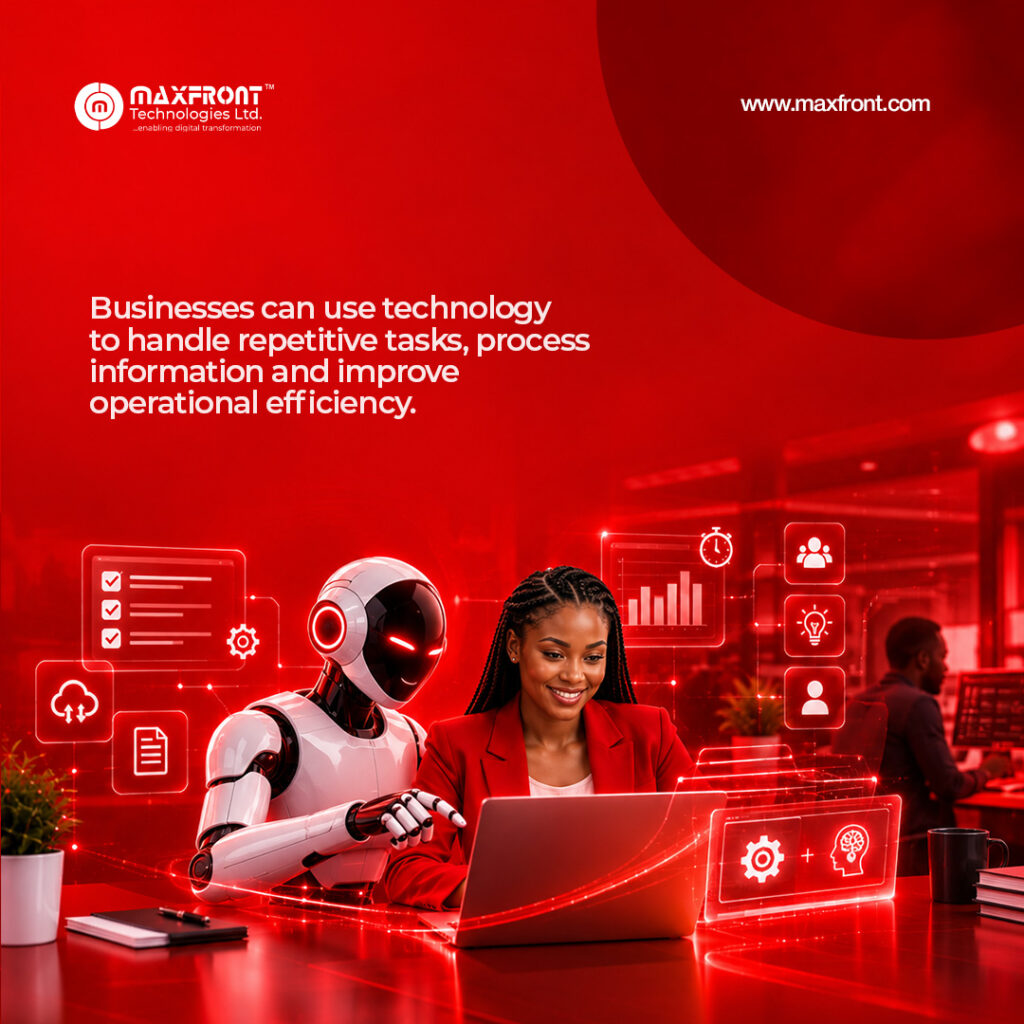
Businesses can use technology to handle repetitive tasks, process information and improve operational efficiency, while allowing employees to focus on areas where human judgement, creativity and interaction remain important.
As AI adoption continues to grow, organisations will need to think beyond simply asking what technology can do. They will also need to consider how technology can improve how people work, how decisions are made, and the customer experience.
This requires organisations to consider not only technology, but also processes, people, data, governance and the broader operating model.
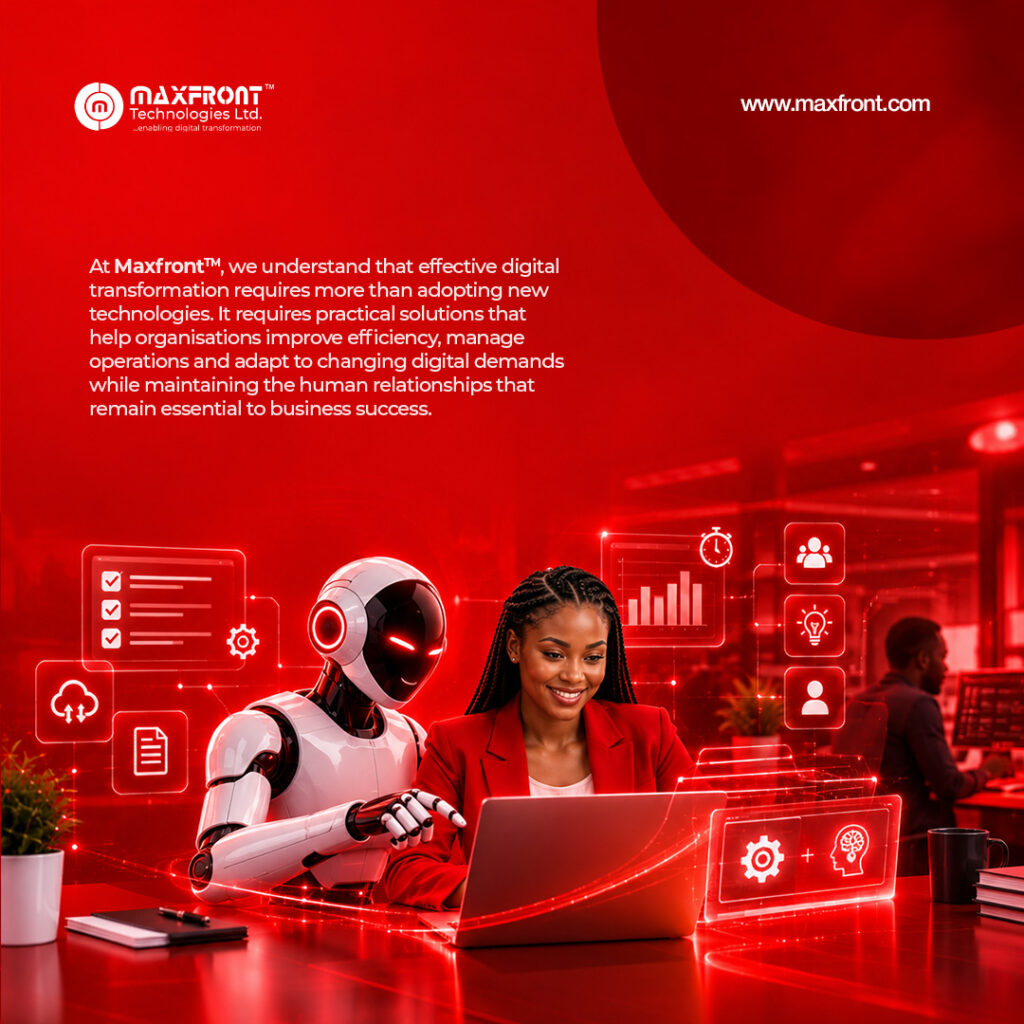
At Maxfront, we understand that effective digital transformation requires more than adopting new technologies. It requires practical solutions that help organisations improve efficiency, manage operations and adapt to changing digital demands while maintaining the human relationships that remain essential to business success.
AI and automation should not make businesses less human. When implemented thoughtfully, they can give people more time, capacity and insight to focus on the work that matters most.