

In today’s digital world, organizations generate vast amounts of information every day. From contracts and invoices to employee records, customer files, reports, applications, and official correspondence, documents are at the heart of business operations.
As organizations grow, managing this information efficiently becomes increasingly challenging. Traditional paper-based filing systems and scattered digital folders often make it difficult to locate documents, control access, track changes, and maintain accurate records.
This is where Electronic Document and Records Management (EDRM) comes in.
More than simply replacing filing cabinets with digital folders, EDRM provides a structured approach to capturing, organizing, storing, retrieving, managing, and preserving documents throughout their lifecycle. It enables organizations to manage one of their most valuable assets—information—in a secure, efficient, and organized manner.
What Is EDRM?
Electronic Document and Records Management (EDRM) refers to the systems, processes, and technologies organizations use to manage electronic documents and records throughout their lifecycle.
An EDRM solution provides a centralized repository where documents can be securely stored, organized, searched, retrieved, and managed according to established business rules and policies.
Instead of spending valuable time searching through filing cabinets, shared folders, or email inboxes, authorized users can quickly locate the information they need through an organized digital environment.
Improving Efficiency Through Digital Workflows
One of the greatest benefits of EDRM is increased operational efficiency.
Documents can be categorized using folders, metadata, keywords, and indexing, making them easy to search and retrieve. This significantly reduces the time employees spend looking for information, allowing them to focus on higher-value activities.
EDRM also supports automated document workflows. Rather than manually circulating documents for review and approval through emails or physical movement between departments, documents can be routed electronically to the appropriate stakeholders.
This improves visibility, reduces processing delays, and enables organizations to monitor document status throughout every stage of its lifecycle.
Strengthening Information Security
Organizations manage highly sensitive information every day, including financial records, contracts, employee information, customer data, and confidential business documents.
EDRM helps safeguard this information through role-based access controls, ensuring that only authorized personnel can view, edit, approve, or share specific documents.
Many solutions also maintain comprehensive audit trails, allowing organizations to monitor document activity, track changes, and improve accountability.
By strengthening information governance, organizations can better protect sensitive data while maintaining stakeholder trust.
Supporting Compliance and Accountability
Many industries operate under legal, regulatory, or internal compliance requirements governing how records should be created, stored, retained, and disposed of.
EDRM supports these requirements by providing structured processes for document classification, retention scheduling, retrieval, archiving, and secure disposal.
Effective records management is not simply about storing documents—it is about knowing:
- What information exists
- Where it is stored
- Who has access to it
- How long it should be retained
- When it should be securely disposed of
This structured approach improves compliance, accountability, and overall information governance.
The Future of EDRM
Emerging technologies are transforming modern document management.
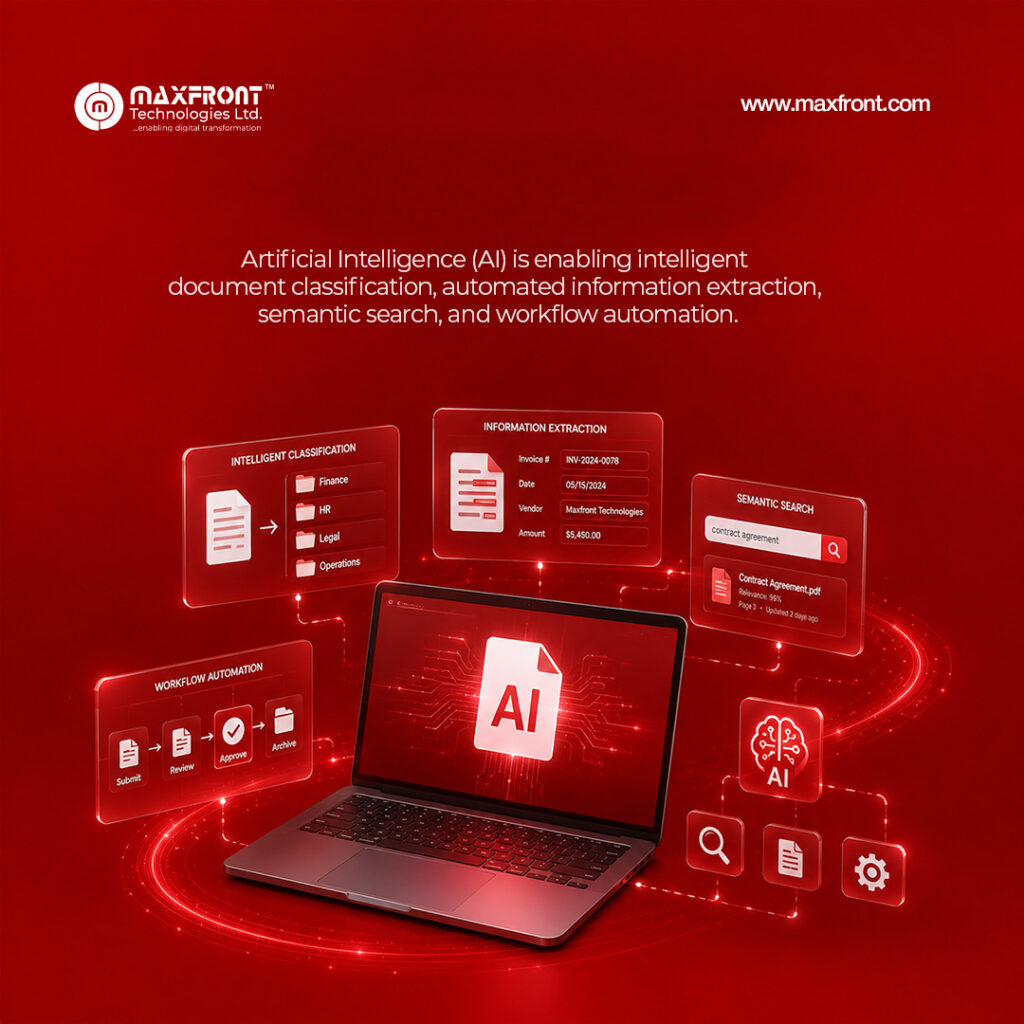
Artificial Intelligence (AI) is enabling intelligent document classification, automated information extraction, semantic search, and workflow automation.
Optical Character Recognition (OCR) further enhances document accessibility by converting scanned documents into searchable and editable digital files.
As these technologies continue to evolve, EDRM is becoming an intelligent information management platform that plays a central role in broader digital transformation initiatives.
However, technology alone is not enough. Successful EDRM also requires well-defined policies, standardized processes, and employees who understand their responsibilities in managing organizational information.
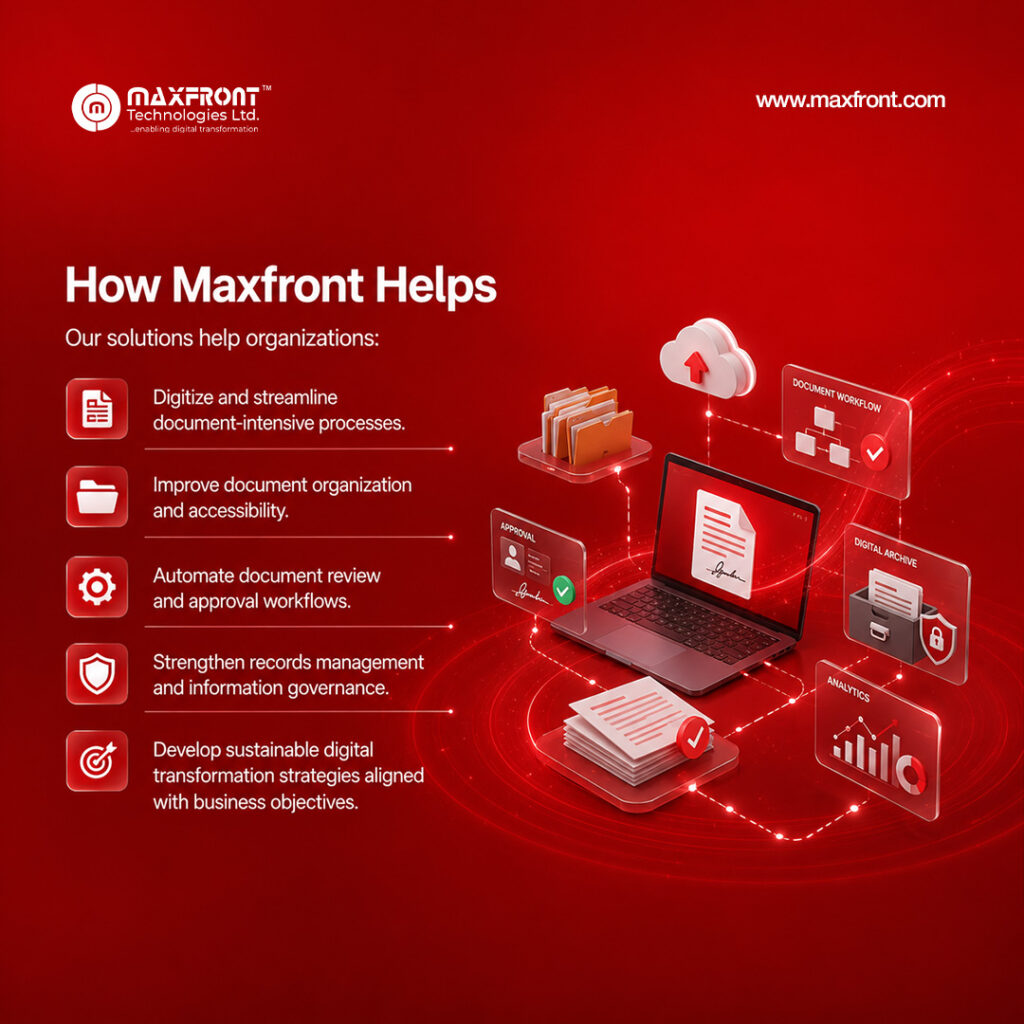
How Maxfront Helps
At Maxfront Technologies, we help organizations leverage technology to improve operational efficiency, strengthen information governance, and accelerate digital transformation.
Our solutions help organizations:
- Digitize and streamline document-intensive processes.
- Improve document organization and accessibility.
- Automate document review and approval workflows.
- Strengthen records management and information governance.
- Develop sustainable digital transformation strategies aligned with business objectives.
As organizations continue to generate increasing volumes of information, adopting the right document management strategy is no longer optional—it’s essential for efficiency, security, and long-term growth.
Ready to Transform Your Document Management Processes?
Discover how Maxfront can help your organization build a smarter, more secure, and more efficient approach to managing information.
Contact us today at info@maxfront.com to learn more.